ADD

Friday, 24 June 2016

Hermann Hesse on Books and Reading


Books and reading don't always get a lot of respect and attention these days.

German-born Swiss writer and painter Hermann Hesse wrote an essay titled “The Magic of the Book” in 1930 that is a reminder about why we love to read books and how important that simple act can be.

The essay is in his posthumously published My Belief: Essays on Life and Art.


Among the many worlds that man did not receive as a gift from nature but created out of his own mind, the world of books is the greatest… Without the word, without the writing of books, there is no history, there is no concept of humanity. And if anyone wants to try to enclose in a small space, in a single house or a single room, the history of the human spirit and to make it his own, he can only do this in the form of a collection of books...

We need not fear a future elimination of the book. On the contrary, the more that certain needs for entertainment and education are satisfied through other inventions, the more the book will win back in dignity and authority. For even the most childish intoxication with progress will soon be forced to recognize that writing and books have a function that is eternal. It will become evident that formulation in words and the handing on of these formulations through writing are not only important aids but actually the only means by which humanity can have a history and a continuing consciousness of itself...

The great and mysterious thing about this reading experience is this: the more discriminatingly, the more sensitively, and the more associatively we learn to read, the more clearly we see every thought and every poem in its uniqueness, its individuality, in its precise limitations and see that all beauty, all charm depend on this individuality and uniqueness — at the same time we come to realize ever more clearly how all these hundred thousand voices of nations strive toward the same goals, call upon the same gods by different names, dream the same wishes, suffer the same sorrows. Out of the thousandfold fabric of countless languages and books of several thousand years, in ecstatic instants there stares at the reader a marvelously noble and transcendent chimera: the countenance of humanity, charmed into unity from a thousand contradictory features.


Hermann Hesse (1877-1962) was born in Germany and later became a citizen of Switzerland. As a Western man profoundly affected by the mysticism of Eastern thought, he wrote many novels, stories, and essays that bear a vital spiritual force that has captured the imagination and loyalty of many generations of readers. In 1946, he won the Nobel Prize for Literature for The Glass Bead Game.

Monday, 20 June 2016

Summer Journals Q-Z


Here's the third and final installment of the list of print journals that read during the summer months. Again, please let me know if you spot any errors or omissions. Good luck!

No rejections allowed.

**Remember that the asterisks indicate that the journal accepts simultaneous submissions.
Journal accepts online submissions unless otherwise indicated.

**Quiddity—2x

**The Raleigh Review—2x—opens July 1

**Rattle—4x

Raven Chronicles—2x—April 1-July 1
snail mail

**Redactions—2x—by email–opens July 1

**Redivider—2x

**Rhino—1x—April 1-Oct 31

**River Styx—3x—May 1 thru Nov 30
snail mail

**Rosebud—3x
via email

**Sakura Review—2x

**Salt Hill—2x
August 1-April 1

**San Pedro River Review—2x
month of July
via email

**Saw Palm—1x—July 1-Oct. 1
must have a Florida connection

**Smartish Pace—2x
via email

**South Dakota Review—4x

**The Southeast Review—2x

**Southern Humanities Review—4x—Aug 1-Dec 1

**Southern Poetry Review—2x
snail mail or via their website

**Sugar House Review—2x—Jan 31-July 31

**Tahoma Literary Review—3x—now thru August

**32 Poems—2x

Threepenny Review—4x—reads thru June

**Turnrow—2x
snail mail

**Tusculum Review—1x

US 1 Worksheets—1x—April 15- June 30
snail mail

**Washington Square Review—2x—Aug 1-Oct 15

**West Wind Review—1x—July 1-Sept 1

**Women Arts Quarterly Journal—4x

**Yemassee—2x


Summer Journals A-F

Summer Journals G-P

Friday, 17 June 2016

Dear Poet - 2016


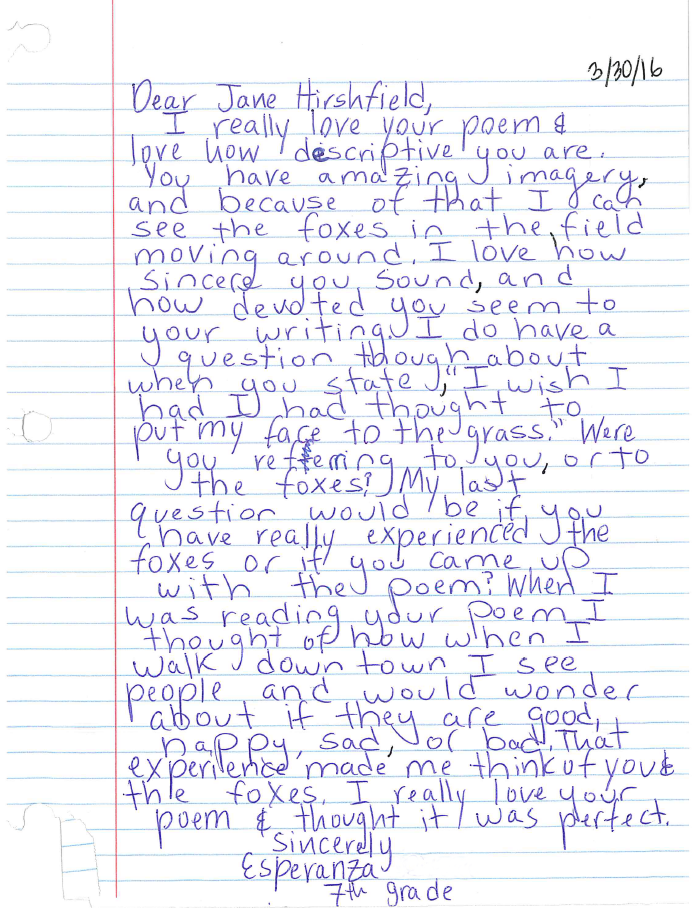
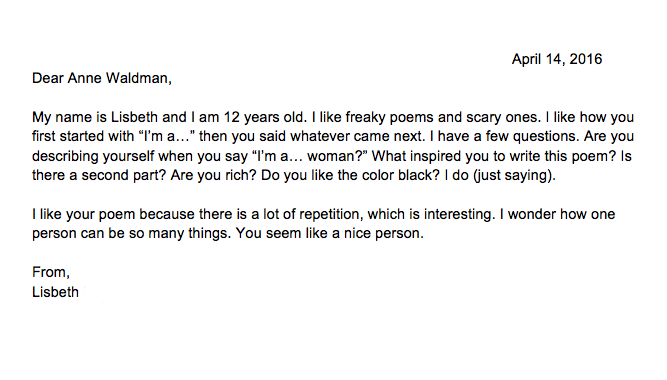
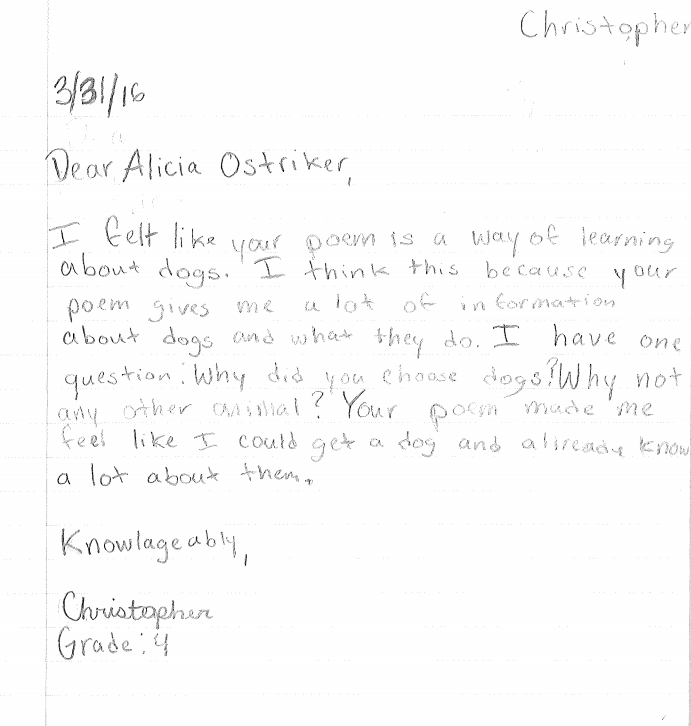
Many classrooms participated in this year’s Dear Poet Project during National Poetry Month writing letters to poets. The Academy of American Poets received over 1,300 letters!

Take a look at the correspondences between students and poets who serve on the Academy of American Poets Board of Chancellors: https://www.poets.org/national-poetry-month/dear-poet-letters-2016


Summer Journals G-P


Here's the second installment of the list of print journals that read during the summer months. If you find any errors or have others to add to the list, please let me know. Good luck with your submissions.

This mailbox is ready to receive good mail.

**Indicates that simultaneous submission is ok
Unless otherwise indicated, the journal accepts online submissions.

**Gigantic Sequins—2x—opens July 1

**Grist—1x—June 15-Sept 15

Hanging Loose—3x
snail mail

**Hartskill Review—3x

**Hayden’s Ferry—2x—opens for submissions August 1

**Hiram Poetry Review—1x
snail mail

Hudson Review—4x—April 1-June 30 (all year if a subscriber)
snail mail

**Lake Effect—1x
snail mail

Little Star Journal—1x
strong preference for snail mail
strong preference for no sim sub

Louisiana Literature—2x

**Lumina—1x—check in July

**MacGuffin—3x
via email attachment

Manhattan Review—2x
(prefers no sim but will take)

Measure—2x
metrical only

**Michigan Quarterly Review—4x

**Mid-American Review—2x

**Minnesota Review—2x—August 1–November 1

**Missouri Review—4x

**The Mom Egg—1x—June 1-Sept 1

**Naugatuck River Review—2x—July 1-Sept 1
for the winter issue

**Nimrod—2x—Jan 1-Nov 30
snail mail

**Parnassus: Poetry in Review—1x
snail mail

Pinyon—2x
via email

**Pleiades—2x—Aug 15-May 15

**Ploughshares—3x—June 3 to January 15

**Poet Lore—2x
snail mail

**Poetry—11x


Summer Journals A-F

Summer Journals Q-Z 

Wednesday, 15 June 2016

Biography & an Interview with Gayle Lauradunn by Caroline LeBlanc

BIOGRAPHY

Gayle Lauradunn is a long time and key figure in the Albuquerque writing community, particularly the poety community where she has just completed a two year tenure as Chair of the Albuquerque chapter of the New Mexico Poetry Society. Under her leadership, the membership increased dramatically. I first met her when I began my gradual relocation here in 2011.  In Summer 2013, we both participated in a workshop with Louise Gluck at the Santa Fe University of Art and Design. Gayle workshoped several of the poems from Reaching for Air at that workshop, and they were well received. Until we all got too busy, Gayle and I were members of a five person poetry writing group.  The following biography is from Gayle.
Gayle Lauradunn reinvents herself about every five to seven years. Along the way she was co-organizer of the first National Women's Poetry Festival, a 6-day event held at the University of Massachusetts, Amherst in 1974. While there she earned a doctorate based on her dissertation for which she used 20th Century American poetry to create a curriculum to teach high school students about race, class, and gender. She learned about the crossover of race and class while living in the poor Black ghetto in Nashville, Tennessee. For five years she participated in the editorial collective that published Chomo-Uri: A Women's Literary and Arts Journal
After earning a B.A. in English Literature at the University of California, Berkeley, she became a feature writer for a weekly newspaper, and over the next 20 years worked as a free-lance journalist. Her anti-Vietnam War activism led her to being the Executive Director of the Veterans Education Project, a group of Vietnam, Korean, and Desert Storm veterans who spoke to high school students about the realities of war and military service.
As a single parent, she travelled extensively with her son throughout the United States, camping, backpacking, white water rafting, exploring museums and historical sites. An avid traveller, she has been to all 50 states and more than 20 countries, Bhutan and Antarctica being her favorites to date.
Her poems have been published in numerous journals, anthologies, and online. The poem "Telling" has been included in numerous anthologies, most recently VEILS, HALOES & SHACKLES: International Poetry on the Oppression and Empowerment of Women, published in Israel.

Interview

Thanks for agreeing to this interview.  I have to say that I am just blown away by the poems in your book.    After this, my 3rd reading I think I’m ready to ask some questions. Your book reads like a memoir, partly of a time forgotten by many in our affluent and urbanized society.  In fact, for me, the stories the poems tell personalize, even as they recall, scenes from The Grapes of Wrath. Here are my questions to you as the poet.

Caroline:  Would you speak about any autobiographical qualities of this book of poems?  Do you regard it as a memoir in verse?
Gayle:Thank you for the opportunity to address some issues I hope the book raises for people. I did not think about it as a memoir until the publisher put it in the double categories of Poetry/Memoir. This caused me to look at the poems differently. Of course, they are memoir, but I didn't set out to write memoir. It had never occurred to me to write one because I didn't want to re-live the pain, the ugliness, the hatefulness of my childhood. The poems began at the Squaw Valley Writers Conference in July 1991 where I spent the week working with Galway Kinnell, Lucille Clifton, C.K. Williams, and Sharon Olds. We were required to have a new poem every morning by 7 a.m. (which we learned after we arrived). I panicked as I had never written a poem a day. The house I shared with five other participants had three floors and the top floor had a balcony just big enough for one chair and a small table. I would sit there and look out across the valley to the mountains in the distance and let my mind go blank. An image, a vague memory, an incident would occur to me and I would write. Of the seven poems I wrote that week, four are in the book, two have been published in journals, and one I threw away.
Since my childhood is post-WWII, I've never thought to make a comparison to The Grapes of Wrath. In my mind, my family was not the Joads. But, of course, we were in many ways. However, I see your point and you've made me think about the comparisons. Which, actually, I prefer not to do.
After leaving Squaw I continued to write these poems over the next several years. What shocked me time after time was how each poem turned out, what each poem revealed to me. I realized that I had carried a burden all my life, that these images were constantly in my head and weighed on me. Since the book has been published, the burden has eased. Unfortunately, there are many more images; I could probably fill another book with such poems, and they occur to me frequently, but I need to move on to other content in my poetry so resist writing them.

Caroline:  Some poems are written in first person, some in third.  Would you say something about how you chose which voice to write in, and perhaps give us more insight into that choice by illustrating with a poem from each voice?
Gayle:I had to write in third person for the childhood poems as a means of gaining distance. It was much too painful to write them in first person with the exception of the few more light hearted ones. The adult voice is in first person because I had both time and geographical distance that allowed me to cope with the images. By the time these poems began, I had not been to Texas for 38 years and had been away from my family for 30 years, living 3,000 miles away in Massachusetts. A good example of a third person poem is:

Suspension
On the porch of broken boards
the child arranges stones into patterns.

Inside her mother wanders
from room to room. She leaves

the house only to stand
on the porch. Rubs her hands.

With slow feet the child
enters. Dries the dishes,

flowers faded and chipped
as though ants had dined.

Watches the hands. Feels
the first sting on her cheek.

Feels the hard leather
on her legs. Long curls snatched

in the hand. She dances a high
jig against the belt.

Tears and pleas will break
the silence. She refuses.

There is no way I could have written this poem in first person. I was always told the slaps were love pats, and I was ridiculed for crying about them. The belt was almost an everyday occurrence. Hence, my desire to escape, to go find the sheep and rattlesnakes.
An example of a first person poem is "Heritage". It takes place more than 16 years after leaving home.

Heritage
In the photograph my son and I stand
in Great-Great-Granddad's corn crib
built of poles glossy from years
of corn-husk polishing, ears fresh picked
to age for cattle feed, side by side
we face the camera, my arm across
his shoulder, my hand rests lightly there.
We stare beyond, as though to see the people
in sun-faded overalls walk the whispery
rows in west Texas heat, and I like to think,
in his child way, he understands what we do,
that he hears them call to each other
down the rows, that he brings their voices
with him into his music, those inward
songs children make of their world.
Since my family no longer lived in Texas and I would have no interference, I took my son who had just turned six to visit for the first time. He still remembers some things about the trip and tells me that these poems help him to recall other aspects. The poem "The Visit" reflects his ambivalence at the time. The focus of the trip was to show him locations and to let him know the contrast between the environment of my childhood and his in western Massachusetts. Also, I wanted him to meet his quite elderly great-grandparents since by then I could protect him from the harshness of my maternal grandmother.

Caroline:  The poems in Reaching for Air do indeed leave one breathless in the way they portray the emotional brutality of grinding poverty and a confusingly duplicitous religious, yet cruel, outlook toward life—particularly from the child’s point of view.  Roughly in what years are the poems set:  for the young girl in the beginning of the book, for the adult returning with her son and to visit her aging grandparents?
Gayle:Most of the poems for the young girl are set in the late 1940s; those of the woman 30-35 years later.
Caroline:Travel, animals and imagination figure large in these narrative poems.  They seem to offer a promise of relief and escape from the prison of poverty, drought, desert and sex-role expectations.  Would you say that is an accurate perception, and if so, share your thoughts about it?
Gayle:Yes, I agree. I took every opportunity to go outside the house, to be on my own, anything to be away from my mother, and my father when he was not working. I was 13 when we moved to Seattle and that was definitely a culture shock: from rural to city, from my Texas twang to the Northwest dialect, from all white (and a few "Mexicans") schools to a school with a mix of African-Americans and Asians, very few of which I had ever seen before. And, worst of all, no space to walk in, no open sky, no horizon to look toward, and no wild animals to relate to. I felt hemmed in with the tall trees and mountains. And, worst of all, very little sunshine. My way of leaving the house was to become involved in many organizations and to sign up for every committee both at school and with various organizations such as Girl Scouts.
I don't know where it came from, but at that young age I desired, absolutely craved, something different. It was more a gut feeling than one I could articulate. I felt there had to be a better life, a better way of being.
I started writing "poems" when I was nine and never stopped. These writings mostly expressed my frustration and anger and feelings of helplessness. I didn't know the word 'power' then but I felt powerless in the most extreme way.
Caroline:Despite the harshness of much of the content, compassion rings through for the various characters in these narrative poems.  How did you, as the writer, find your way to writing in such a factual, yet non-attacking manner?
Gayle:I let the facts and images speak for themselves. I try to write poems that tell a story, that paint a picture. I want the reader, or listener, to see and hear the story. I want readers to decide for themselves, based on the facts and images, how they feel and think about the various characters. We all like stories, whether they make us laugh, cry, or cringe. Stories are what we all remember. I want my poems to communicate to a broad audience and stories do that.
Caroline:  How long did it take you to write this book?  What did the process of writing it entail for you?
Gayle:It was written sporadically over a period of 15 or so years beginning in 1991. I wasn't trying to write a book, only poems as they occurred. In Massachusetts I was a member of a critique group that met weekly. Timothy Liu (https://www.poets.org/poetsorg/poet/timothy-liu)was also a member for about 3 years and he was the person who said the poems make a book. I was surprised, but Tim insisted and created the first arrangement of the poems. The final arrangement is close to what he suggested although I did delete some poems and wrote new ones later that are included.
Until recently I have never been able to write consistently yet never stopped writing. Being a single parent with no money and poor health, I struggled through graduate school and numerous part-time jobs. My son also had health issues and between the two of us I spent a lot of time in doctors' offices. When my own issues were finally diagnosed in 1988, I was then able to work full time and not worry constantly about money. Writing was a compulsion, an obsession, something I needed to do that was all mine. I always wrote in a hurry and, therefore, wrote a lot of bad poems, never having the time to revise. I have stacks of those poems that I have looked through to determine what could possibly be salvaged. Very little, yet I hang on to them because, I think, they remind me of my journey.
Caroline:Please tell us of your journey to get Reaching for Air published?
Gayle:I sent the manuscript to about 40 publishers over some eight or ten years. During that time I continued to revise. In 2013 I took a workshop with Louise Gluck whose help and support were invaluable and gave me the courage to force the issue and self-publish. Over the years of this journey I began to realize from the comments that editors made, that they either didn't understand the poems or were in denial about the issues of class the poems raise. As a country we love to talk about, lament about, debate about, rant about racism. But we don't like to even mention class. I've noticed that when it is mentioned on the news, it is quickly passed over. As a child, I was painfully aware of the difference between my home and that of a few friends whose middle or upper middle class homes I was invited into, but I did not understand that this was part of the class difference. People don't like to admit that white people are poor. In 1976 I was invited to apply for a Danforth Foundation Grant for Women to help finance work on a graduate degree. The application form was lengthy and required several in-depth essays. On the third line of one of the essays I stated that I am white. Yet, when I arrived at Harvard University for an interview, the self-satisfied pompous white woman who had summoned me took one look at me and said "I thought you were black". End of interview. She couldn't imagine a white person having the experiences I had had.
In 1967 I was living in Nashville where my husband taught at Fisk University. We lived in the faculty housing that surrounded the campus that sits in the midst of the poorest part of the black ghetto (I don't know if anything has changed since I've never returned there). A few houses up the street Robert Hayden resided with his family. He asked to see my poems and I invited him for tea. Sitting in the living room the conversation turned to the location of the campus in the midst of such poverty. I'll never forget Bob's words as he gestured to the surrounding area "I have nothing to do with these people". That was my first instruction that class crosses racial and ethnic lines.
He was a wonderful man with whom I had a number of stimulating conversations. I was extremely pleased for him when he was named U.S. Poet Laureate. And, I will always be grateful to him for being the first to publish my poems. At the time he was poetry editor of the Baha'i journal World Order. About a year later two of my poems appeared in the journal.
Later that spring I had further instruction in the vagaries of class when I participated in a door-to-door survey conducted by a group of doctors who were determining whether to build a low-cost or free health clinic in either the poor black ghetto or the poor white ghetto. The questionnaire required about 45 minutes to ask people questions and record their responses. I was assigned homes in both ghettos. The residents had no idea I would be knocking on their doors. What a revelation! For the most part the white homes were a mess with clothes thrown everywhere and dishes piled up in the sink. The rooms were often filthy. The people spent a lot of time ranting about how they were better than the blacks (of course they used a different word) because they were white. By contrast, the black homes were poor, sometimes no better than shacks, but neat with clothes hung up on wooden pegs on the walls and everything clean. The people were polite and gracious although a bit uncomfortable with the white lady who came calling. These experiences reflected my own uneasy but not yet fully acknowledged awareness of and experience of the class divide.
Thanks to the pervasive denial about class in our society, I don't think Reaching for Airwould ever have seen the light of day unless I published it myself. I was gratified when it was named a Finalist for the Best First Book of Poetry by the Texas Institute of Letters.
Caroline: What are you working on now?
Gayle:My second poetry manuscript is completed and looking for a publisher. The title is All the Wild and Holy: a Life of Eunice Williams, 1696-1785, a book-length narrative poem in the voice of the historical figure of Eunice Williams. I was pleased that it received an Honorable Mention for the May Sarton Poetry Prize by Bauhan Publishing. Currently, I am writing a series of travel poems to reflect my passion for travelling to learn about the world and other peoples in more than a superficial manner. Another project is to write poems about the pre-historic Greek goddesses who were worshipped before the northern patriarchal invaders arrived and destroyed the power of women that threatened the warriors.
I have a number of poems stashed away that I've long thought of as singletons. Recently I pulled them all together and discovered that about 50 of them could comprise a manuscript. Over the next few months I'll be revising these and writing a few more that fit into the three sections I've divided them into.
On a completely different tack, I'm excited about writing my first novel. Since it is such a different process from writing poetry, it is a very steep learning curve. But I am enjoying it as well as the frustrations involved. The story is set in the late 18th century in the Scottish Highlands, then, through many misadventures, proceeds to Iceland, and ends in the Boston. It follows the woman's journey based on Joseph Campbell's hero's journey. It is the first book in a trilogy.
Caroline:  Thanks for your time, Gayle.  I look forward to seeing your manuscripts in script. 


Caroline LeBlanc, former Army Nurse and civilian nurse psychotherapist, has had her essays and award winning poetry published in the US and abroad.  In 2010, Oiseau Press published Smokey Ink and a Touch of Honeysuckle, her chapbook about life as an Army wife and mother, and the descendent of 17thCentury Acadian/French Canadian settlers in North America. As past Writer in Residence at the National Military Family Museum, she wrote the script for the museum’s traveling exhibit, Sacrifice & Service; co-produced and co-created the script for Telling Albuquerque and 4 Voices stage performances; and facilitated Standing Down, a NM Humanities Council book discussion group for veterans and family members. With Mitra Bishop, Roshi, Mountain Gate Zen Center, New Mexico, she offers veterans and women military family members day long Mindfulness Meditation/Mindful Writing Retreats.  She also serves as clinical staff for Mountain Gate Regaining Balance residential retreats for the same individuals.  Before leaving the Fort Drum, NY area, in 2012 she offered Writing For Your Lifeprograms to wounded warriors and military family members.  In 2011, Spalding University awarded her a Masters of Fine Arts in Creative writing.  Her art has won awards in New York and New Mexico.  She is a member of Albuquerque’s Rainbow Artists Collective, and a founding member of the Apronistas Collective of women artists who regularly mount community art shows highlighting women’s rights and ecological issues.   


Reaching for Air: Poems of Trauma & Relislience in a Poor White Country Girl's Life, a Review by Caroline LeBlanc

Reaching for Air


by Gayle Lauradunn

Mercury HeartLink Press, 2014.

ISBN 978-1-940769-17-2

Reaching for Air on Amazon


The poems in Reaching for Air capture, and celebrate, one person’s triumph over grinding poverty, as well as the multigenerational physical and emotional cruelty such poverty can engender.  These poems take the reader beyond racial, historical, and demographic stereotypes: they are about childhood hardships and abuse—physical and emotional—survived by a little white girl in poor, rural American around the middle of the 20th century.   In the attached interview, the poet states clearly that these poems are about her life, and describes how she finally put these difficult personal experiences on paper.  I’ve spoken to many people who want to, or are trying to do just that in a way that creates good poetry, as well as recounts personal experience.  If you are one of these people, and even if you’re not, this book is worth a read because the poems are compelling and just plain good quality.
The book’s fifty-five poems are divided into five sections, plus a prologue and epilogue.  Most are set in the parched and forbidding farmlands of west Texas.  The young girl’s experiences, related largely in the third person, drive most of the poems in this memoir-like collection of poems.  The other driving characters are: a father with wanderlust inherited from his mother, beaten over and over again by the weather and parched farms; a mother, angry about what her life has become, impotent against her husband’s willfulness, and all too ready to take her frustration and anger out on her young daughter.  The dynamics depicted in these mother-daughter poems recall how girls can be hated and mistreated by the very women who should love them  most, because these young girls are painful, jealously evoking, reminders of dreams and hopes forever lost to the grown woman.  
Grandparents are minor characters. The only kindness recorded is Granny’s gift of books “[t]hree times a year”.  However, in the child’s house, even the best of these treasures disappears, only to be found “later/shredded in the trash bin,” presumably by the jealous mother (“Gift”).” Even Sunday’s chicken dinner, and a bountiful peach harvest are tinged with cruelty. After every classically boring Sunday drive, Granddad kills a chicken in front of the child, immediately before the dinner when the child is expected to eat its meat (“Chicken Every Sunday”).  Sweet peaches become a cruel lesson about perceived ingratitude when she refuses yet another peach, and Granddaddy “pushes the golden fruit into her mouth,/the softness hard against her teeth “(“Re-Gold in Sunlight”).  

The only adult without malice seems to be Great-Uncle Buddy who “keeps us all entertained with his story.”  Turns out Great-Uncle Buddy lives in “the great white bed where he lies in fetal position” and has since he was paralyzed at age 17 after he was “thrown from a mule.”  Who had cared for this man is not clear, but he alone among the clan seems free of the cruel rage sprouting from despair and poverty.  The last lines of the poem are: “The skin stretches/over his parchment face as he grins/with the humor he’s invented to keep us there” (“Punch Lines”). And the family was starved for humor.

As is so often the case when the personal mother and/or father is unable to nurture a child, the child in these poems finds solace in nature:  flowers, turkeys, sheep, cows, horses, even snakes.  Not surprisingly, the parents are hardened to and insensitive about even this.  In “At the Zoo” the parents force, then watch, their terrified child ride a circus elephant.  One imagines that they could not understand why the child was not happier and more appreciative about this treat.  Still, the child pulls through, as the “elephant lifts its feet/in rhythm with soft drumming,/sways its stately body/in a cradle song.”  One takes soothing where one can find it.

“Dehorning Molly” is particularly compelling.  It seems Molly is one of the child’s favorite cows, whom she “strokes in rhythm.//traces a white patch over the nose.”   Then:

                Into this animal world
                the men come:
                her father, her uncle,
                the neighbor Mr. Renfrow.
                They carry thick ropes
                and a saw with jagged teeth.
                A thick piece of lumber.

                The child looks out to the field
                 sprouting white bolls.
                 A light breeze
                stirs her hair.
                Through the bellows
                she hears
                the rasp of the saw.

                Later, her father said
                she was too frisky,
                butting into the barn,
                tossing her head
                as though those horns
                meant something.

Clearly, the misogynistic message was not lost on the child.  Yet, despite these wearying incidents of cruelty, the child continues to seek refuge in the natural world, and even manages to redeem some tragic habits of past generations, particularly through travel in the outer and inner world.  “The Visit” recounts the time she took her young son back to her “genesis under west Texas//sky.  He shrinks in this alien landscape/while [she] can breathe again.” She compassionately shows him things intimately familiar to her, yet alien to him.

             On the sheep-graze we find my refuge           
              the oak clump of childhood solitude.
              I tell him to keep walking

              if we see a rattler. It is harmless
             if uncoiled. I forget he has not known
             
             this since he could walk. His tears

             surprise me.  I point to shapes
             in the clouds, in the sky
             
             that surrounds him. On the ground


              he draws in the dirt with his finger,
              refuses to look up. His eye unused

              to travelling so far.

In “Birth Rite,” the book’s closing poem, the poet recounts how her father caught her mother eating dirt early in the pregnancy with this future poet. (For those who don’t know, as I didn’t before I took care of my first pregnant patient from the rural South, eating dirt is a bit of a tradition in the South, particularly poor, hungry, and malnourished pregnant women).  For me, the poem calls to mind the Tibetan Book of the Dead, where one confronts the elemental reality of one’s physical non-existence, and in the end lives more fully.  Forever finding comfort in nature, rather than adversity as her ancestors did, the poet writes,
                Perhaps being bread on worms
                is ok    it gives me
                my love of nature
                my desire to be in the woods
                in the mountains
                near the ocian (sic)

Her imaginary journey into the soil, the earth with its worms continues:


                they are at home in the dark
                slowly my arms sink
                into the dirt
                a soft slither startles me
                worms creep up and
                over my back
                at first a few but finally
                hundreds
                i nod good day
                and go on digging

                the ridges of my knuckles
                flex
                each finger drops off
                at the joint and
                inches away
                worms basking
                on my back slough off
                and dig beside me
                the tunnels stretch
                into a glow
                ahead I see a spoon

The poems in Reaching for Air are straight forward in their style and the stark honesty of their content.   They tell of the tragic paradox of misguided love, for I am sure that if asked, the parents and grandparents in these poems would say they loved their daughter, and that would be the justification for their behavior. The poems tell of the resilience of a young girl, grown into a woman who can look at the past honestly, and step into the future with courage.  In no way are they self-indulgent or self-pitying.  That fact, and the poet’s craft, especially the rich sensory descriptive details in the poems,  makes reading this book a rewarding, dare I say joyful, experience.  The collection contains previously secret truths from one person’s life, and the skillful telling invites readers to examine other truths hidden in our collective and personal lives.


Summer Journals: A-F


Get your mailbox ready to receive good news.

It's that time of year again. During the summer many of us have more time to write and submit, but quite a few journals close their doors to submissions for the summer months. Do not despair. There are still many journals that do read during the summer and some that read only during the summer. This is the first of a 3-part list of those journals, all print. Please note that this year I have done only minimal updates. Be sure to check website.

I've added links for your convenience. I've also indicated the number of issues per year, the submission period dates, which journals accept simultaneous submissions, and which ones accept online submissions. If you find an error, please let me know.


**Indicates that simultaneous submission is ok
Unless otherwise indicated, the journal accepts online submissions.
If no dates are given, the journal reads all year.


**American Poetry Review—6x-tabloid

**Asheville Poetry Review—3x—Jan. 15-July 15
snail mail

**Atlanta Review—2x—deadlines June 1 & Dec 1
reads all year, but slower in summer
snail mail

**Bat City Review—1x—June 1-Nov 1

Beloit Poetry Journal—3x

**Black Warrior Review—2x—June 1-Sept 1

**Bone Bouquet—2x
women only

**Briar Cliff Review—1x—deadline Nov 1

**Burnside Review—2x
email sub ok
$3 reading fee /pays $50

**Caketrain—1x
email sub

**Chariton Review—2x
snail mail

**Cimarron Review—4x

**Columbia Journal—2x—March 1- Sept 15

**Columbia Poetry Review—1x—July 1-Nov 1

**Conduit—2x
snail mail

**Crab Orchard Review—2x—Aug 15-Nov 5 (special issue)
snail mail

**Cream City Review—2x—Aug 1-Nov 1

Cutthroat—1x—July 15-Oct 1

**Edison Literary Review—1x

Field—2x—August 1-May 31

**The Florida Review—2x—Aug 1-May 31 (subscribers all year)

**The Fourth River—1x—opens July 1


Summer Journals G-P

Summer Journals Q-Z

Monday, 13 June 2016

Lin-Manuel Miranda's Sonnet at the Tony Awards

Photo: Sara Krulwich/The New York Times

When Lin-Manuel Miranda accepted his award for best score for Hamilton at the Tony Awards last night, the audience might have expected hip hop, rap or freestyling. But he chose a sonnet as his acceptance speech form.

The sonnet not only acknowledges the show and his wife, Vanessa, but also references the tragic shooting massacre in the early morning hours of the day in Orlando, Florida.


My wife’s the reason anything gets done
She nudges me towards promise by degrees
She is a perfect symphony of one
Our son is her most beautiful reprise.
We chase the melodies that seem to find us
Until they’re finished songs and start to play
When senseless acts of tragedy remind us
That nothing here is promised, not one day.
This show is proof that history remembers
We lived through times when hate and fear seemed stronger;
We rise and fall and light from dying embers, remembrances that hope and love last longer
And love is love is love is love is love is love is love is love cannot be killed or swept aside.
I sing Vanessa’s symphony, Eliza tells her story
Now fill the world with music, love and pride.


Tuesday, 7 June 2016

Enter to Win a Free Copy of The Doll Collection


Goodreads Book Giveaway


The Doll Collection by Diane Lockward

The Doll Collection

by Diane Lockward


Giveaway ends June 14, 2016.

See the giveaway details
at Goodreads.


Enter Giveaway

Sunday, 5 June 2016

Fairy Tales

Illustration by Yuko Shimizu from The Wild Swan

Fairy tales are a type of short story that typically features fantasy characters (dwarves, elves, fairies, giants, gnomes, goblins, mermaids, trolls, witches) and usually some magic or enchantments. They differ from other folk narratives such as legends which generally involve some belief in at least some truth to the tale.

We usually think of fairy tales as children's literature, but authors have also written modern and more adult fairy tales.

Like many of us, author Michael Cunningham read fairy tales as a child, but he continued to wonder about what happened after the tales ended. In his collection of stories, The Wild Swan, he answers that question for a number of fairy tales. Cunningham is best known for his novels The Hours and The Snow Queen (which was inspired by a Hans Christian Andersen story).

He gives us a a modern day lazy boy named Jack who lives in his mother's basement rather than get a job. One day he trades a cow for some magic beans. His poor widowed mother is stuck with this kid who is "not a kid who can be trusted to remember to take his mother to her chemo appointment, or to close the windows when it rains." But her opinion of him changes when he climbs the beanstalk and comes back with bags of gold. Mom invests in stocks and real estate. They build a mansion for themselves. He climbs the beanstalk again, More gold and they are able to buy everything they ever wanted. But Jack goes back again for even more gold even though "there's nothing left for him and his mother to buy."

In "Kissing the Toad" by Galway Kinnell, he takes that idea that appears in several fairy tales.

Somewhere this dusk
a girl puckers her mouth
and considers kissing the toad a boy has plucked
from the cornfield and hands
her with both hands;
rough and lichenous but for the immense ivory belly,
like those old entrepreneurs
sprawling on Mediterranean beaches,
with popped eyes,
it watches the girl who might kiss it,
pisses, quakes, tries
to make its smile wider:
to love on, oh yes, to love on.

We also use the term "fairy tale" to describe something unusually, perhaps unrealistically, optimistic, as in "fairy tale ending" or a "fairy tale romance." Of course, not all fairy tales end happily, and some are quite grim (or Grimm).

In her book, Transformations, Anne Sexton has a number of poem-stories in her retelling of seventeen Grimms fairy tales, including "Snow White," "Rumpelstiltskin," "The Frog Prince," "Red Riding Hood" and "Rapunzel". She takes the original story and gives it a modern turn that goes much further than the modern Disney version of the character, as this opening to the poem shows:

A woman
who loves a woman
is forever young.
The mentor
and the student
feed off each other.
Many a girl
had an old aunt
who locked her in the study
to keep the boys away.
They would play rummy
or lie on the couch
and touch and touch.
Old breast against young breast…
Let your dress fall down your shoulder...


For this month's prompt, you may choose from several fairy tale possibilities:
- Continue a classic tale, or following Cunningham and Sexton, rewrite a classic for our times.
- Choose a part of the plot or an element from a tale, as Kinnell did or as in A.E. Stallings "Fairy-tale Logic."

I found in my local library a copy of  Disenchantments which anthologizes a good number of modern day fairy tale poems.

Submission Deadline: July 3, 2016