Tuesday, 27 August 2013
Marco Polo by Ali Alizadeh
Marco Polo
Maybe it’s the natural
extension of immigration. Maybe
it’s the awesome travel
bugs, making my wife’s feet
uncommonly itchy. I’m not
surprised, at any rate, to hear
the paediatrician’s nickname
for our son. ‘Marco Polo’ suits
his - in utero - trajectory
along the Silk Road, from
Kublai Khan’s Forbidden City
to the snow-covered stones of a caravanserai
in central Turkey

Monday, 26 August 2013
Poems About the Body

Landscape.
Politic.
Costume.
Confession.
Debt.
Declaration.
What you wake into.
What you dance out of.
A body.
The body.
A few weeks back, Facebook friends offered suggestions for poems about the body. Here is a variation of that list, in no particular order and with links to texts (always best to check online texts against the original source). Suggestions came from poetry lovers, teachers, editors, and authors, including Ada Limón, Kirsten Sundberg Lunstrum, and Robert Pinsky. Enjoy~
("Nude, 1936," Edward Weston)
"A Story about the Body" by Robert Hass
"homage to my hips" by Lucille Clifton
"My Beloved" & "Breasts" by Charles Simic
"The Consolations of Sociobiology" by Bill Knott
In Posse Review's "Poetry and the Body" issue by various
"Embalming" by Scott Cairns
"[i like my body]" by e.e. cummings
"The Plan is the Body" by Robert Creeley
...no text, but audio of Creeley reading here
"Catalyst" by A.R. Ammons
"Spring and All" by William Carlos Williams
"Passages 18: The Torso" by Robert Duncan
"Ode to My Hands" by Tim Seibles
"The Race" by Sharon Olds
"History of My Body" by Marie-Elizabeth Mali
...no text, but video of Mali reading here
"the floating poem, unnumbered" by Adrienne Rich
"Sonnet XXVII" by Pablo Neruda
"Hands" by Sarah Kay
...no text, but video of Kay reading here
"First Poem for You" by Kim Addonizio
“Thirty Lines about the Fro” by Allison Joseph
“A Hand” by Jane Hirshfield
“Sean Penn Anti-Ode” by Dean Young
“The Routine Things Around the House” by Stephen Dunn
“Consider the Hand That Writes This Letter” by Aracelis Girmay
"New Heaven and Earth" by D. H. Lawrence
"Mummy of a Lady Named Jemutesonekh" by Thomas James
"The Bladder" by David Keplinger
"My Husband's Back" by Susan Minot
"Not the Furniture Game" by Simon Armitage
"The Connoisseuse of Slugs" by Sharon Olds
"Samurai Song" by Robert Pinsky
"Strongly Scented Sonnet" by Rhoda Janzen
"The Cleaving" by Li-Young Lee
"Question" by May Swenson
"The Lovers" by Dorianne Laux
"Free Union (L'Union libre)" by André Breton
"I Knew a Woman" by Theodore Roethke
"The Language of the Brag" by Sharon Olds
"I Sing the Body Electric, Especially When My Power's Out" by Andrea Gibson
...or video of Gibson reading here
"The Body is Not an Apology" by Sonya Renee
...no text, but video of Renee reading here
"How to Make Love to a Trans Person" by Gabe Moses
"In Celebration of My Uterus" by Anne Sexton
"Hip-Hop Ghazal" by Patricia Smith
"Anodyne" by Yusef Komunyakaa
...or video of Komunyakaa reading here
"Anything from..."
e.e. cummings
Beth Bachmann's Temper
Frank Bidart
Walt Whitman
Sharon Olds
David Keplinger's The Most Natural Thing
Stacey Waite's Butch Geography
Morgan Lucas Schuldt
Sally Rosen Kindred suggested Lisa Russ Spaar's "Hallowe'en," going so far as to type it out. (The poem appears nowhere online and Glass Town, Spaar's first collection, is out of print.) I've loved that poem for years, so thanks to Sally for the excuse to share it here:
HALLOWE'EN

of small, masked demons
begging at the door,
a man cradles his eldest daughter
in the family room. She's fourteen,
she's dying because she will not eat
anymore. The doorbell keeps ringing;
his wife gives the sweets away.
He rubs the scalp
through his girl's thin hair.
She sleeps. He does not know
what to do.
When the carved pumpkin
gutters in the windowglass,
his little son races through the room,
his black suit printed with bones
that glow in the dark.
His pillowsack bulges with candy,
and he yelps with joy.
The father wishes he were young.
He's afraid of the dream
she's burning back to,
his dream of her before her birth,
so pure, so perfect,
with no body to impede her light.
~Lisa Russ Spaar
Monday, 19 August 2013
John Hollander: An Appreciation

So I looked for MFA programs that heeded form and world traditions, which brought me to American University, and Washington, DC. I took a full-time job at the Phi Beta Kappa Society's national headquarters to cover tuition and living expenses, and discovered that Hollander was one of the judges for a book prize I administered. When I came on board, all of the first-round reads were already sent out--except, I realized, a book that had been misfiled under the award for poetry (creative) versus poetry (criticism). I leafed through the book, thought "This looks substantial," and pleaded with my supervisor that it should be considered. She said, OK--if I could convince a judge to take on an extra book. That judge turned out to be John Hollander ("talk poet to poet," I steeled myself before asking him) and the book, Susan Stewart's Poetry and the Fate of the Senses, went on to win the 2003 Christian Gauss Award for Literary Criticism. One of my earliest lessons that even when you're an underling, paying attention and speaking up can change the course of events.
Of course, as any administrator will attest, some of our exchanges were less fruitful. I once had to plead with him to turn in some overdue reader reports. He responded by saying the books in question had been delivered to his mailbox at the end of his driveway, but his driveway was long and very icy, and did I want him breaking a bone in the name of Phi Beta Kappa? His voice was kind in phone calls, but reserved.

"A line can be end-stopped, just like this one,
Or it can show enjambment, just like this
One, where the sense straddles two lines: you feel
As if from shore you'd stepped into a boat;"
Or this:
"Milton and Wordsworth made the sonnet sound
Again in a new way; not with the sighs
Of witty passion, where fierce reason lies
Entombed in end-stopped lines, or tightly bound
In chains of quatrain: more like something found
Than built--a smooth stone on a sandy rise,
A drop of dew secreted from the sky's
Altitude, unpartitioned, whole and round.
The octave's over; now, gently defying
Its opening tone, the sestet then recalls
Old rhythms and old thoughts, enjambed, half-heard
As verses in themselves. The final word,
Five lines way from what it rhymes with, falls
Off into silence, like an echo dying."
I'll be honest: Rhyme's Reason is rarely the students' favorite part of the semester. For most of them, his didactic exercises go down like cough syrup, his jokes seem contrived, his tastes old-fashioned. They're only too happy to scoot along to free verse and talking about what the poem means to them. But there's always one or two who perk up--who appreciate, like I did in college, that intensity of wit and those acrobatics of language, and who embrace that poetry can have both objective and subjective qualities. For those one or two students, he's a revelation. The lineage continues.
Rest in peace, John Hollander. You were a brilliant scholar. You shaped my ear, and my sensibility (and many more than me, more than a simplistic head-count of "formalists" would describe). Yet you were also a real person in the real world, and that helped me envision a future where I, too, could be a real poet. I am so grateful.
Early Growth by Rachel O'Neill
At her party the boy runs best with the hard-boiled egg. During
the obstacle course she meets him at the bird feeder on top of
which raisins are scattered. ‘I’m a bird,’ she nibbles and the boy
really does bob and nod. Later he says, ‘we’re twins, and I can
telepathically read the thoughts in your head,’ at which point she
makes a dent in his leg. It’s spring. Sometimes she hears an animal
cry as
the obstacle course she meets him at the bird feeder on top of
which raisins are scattered. ‘I’m a bird,’ she nibbles and the boy
really does bob and nod. Later he says, ‘we’re twins, and I can
telepathically read the thoughts in your head,’ at which point she
makes a dent in his leg. It’s spring. Sometimes she hears an animal
cry as
Sunday, 18 August 2013
Breaking Bad and Walt Whitman


There have been several Walt Whitman references during the four and a half seasons of AMC’s Breaking Bad. This month the final episodes of the series are being shown.
The two WW's - Whitman and Breaking Bad protagonist, Walter White - have a strange connection.
The two don't seem similar. White is a high school science teacher who finds out he has cancer and becomes a crystal meth maker and distributor to build up a cash reserve for his family. Over the seasons, he breaks very bad, going “from Mr. Chips to Scarface” as the show's creator, Vince Gilligan, has said.
Whitman is nothing like that. Whitman and his book, Leaves of Grass, were not part of some original plot plan by the creator, But he keeps popping up.
In season three, White’s lab assistant, Gale, recites Whitman's poem “When I Heard the Learn’d Astronomer", a poem about disillusionment with theory and a need to engage with the world.
When I was shown the charts and diagrams, to add, divide, and measure them,
When I sitting heard the astronomer where he lectured with much applause in the lecture-room,
How soon unaccountable I became tired and sick,
Till rising and gliding out I wander’d off by myself,
In the mystical moist night-air,…
Gale gives Walt a copy of Leaves of Grass as a gift. In a later scene, Walt read the book which Gale inscribed with “To my other favorite W.W. It is an honor working with you.”
The name of this year's fifth season’s midpoint cliffhanger episode was “Gliding Over All,” which is an allusion to a poem in the book, "Song of Myself."
Gliding o’er all, through all,
Through Nature, Time, and Space,
As a ship on the waters advancing,
The voyage of the soul—not life alone,
Death, many deaths I’ll sing.
This poem connects with the Walt that White has become.
And then Walt’s brother-in-law Hank, a D.E.A. agent who has been pursuing the meth cook that is Walt, found the copy of Leaves of Grass in Walt's bathroom, and reading the inscription written by the now dead Gale, knows that Walt is the meth cook and drug lord also known as "Heisenberg."
Walter "Walt" Whitman the poet was a humanist and part of the transition between transcendentalism and realism. He is among the most influential poets in the American canon, often called the father of free verse.
His work was very controversial in its time, particularly Leaves of Grass, which was described as obscene for its overt sexuality.
Will "The Good Gray Poet" figure in the final episodes of the series?
As at thy portals also death,
Entering thy sovereign, dim, illimitable grounds...
I grave a monumental line, before I go, amid these songs,
And set a tombstone here.
More About WW and WW
http://breakingbad.wikia.com/wiki/Walt_Whitman
http://www.poetryfoundation.org/article/246218
Monday, 12 August 2013
Fringe Festival Comes to a Close

Sheila Packa and Kathy McTavish at Intermedia Arts photo by Pam Colby
The Minneapolis Fringe Festival has completed the 2013 event. Thank you so much for coming to our show! Night Train / Red Dust presents stories of the Iron Range: women's stories, labor history, mining, and immigrant stories set in deeply resonant sound and image environment. If you would like us to present this show in your venue, please contact me at sheila@sheilapacka.com
The Hangman
Over the weekend I was looking up pastor Martin Niemöller's poem ("First they came for the communists...."), which I had push-pinned to the wall of my teenage bedroom. Along the way I found this, which I'd never seen before: a 1964 short video adaptation of Maurice Ogden's poem, "The Hangman." The production team is Paul Julian, who did the animation, and director Les Goldman. The narrator is character actor Herschel Bernardi, who was the singing voice of Zero Mostel in the Broadway launch of Fiddler on the Roof (he also voiced the Jolly Green Giant, and Charley the Starkist Tuna, though that seems almost unfair to mention). The music is composed by Serge Hovey, who was also part of the effort to record the complete songs of Robert Burns.
This is really quite beautiful--and chilling. Now that I've seen it, I can't get it out of my head. Thanks to the Academic Film Archive of North America for archiving it online.
Grass by Jill Jones
Empty girl I was, so far inside, grass didn't know me
It was something unbending, only light seemed to touch
But so long as I could smell the sea, so long as salt
I had extrications, music, that fire, phase & beat
And all around the world went off, banners & avenues, cruelties
Now it's come one, come all, a kind of sassy hoedown
The grass is going, it cracks & withers sadly, almost infinitely
But
It was something unbending, only light seemed to touch
But so long as I could smell the sea, so long as salt
I had extrications, music, that fire, phase & beat
And all around the world went off, banners & avenues, cruelties
Now it's come one, come all, a kind of sassy hoedown
The grass is going, it cracks & withers sadly, almost infinitely
But
Tuesday, 6 August 2013
Poetry Calling
 Last night we had a big crowd for the Omission Summer Poetry Tour's stop at Baked & Wired (which serves all your standard coffeehouse fare...plus sweet tea so rich it should carry a warning label...plus bacon cupcakes). The work was great; as I told the audience, this felt like a snapshot of What's Being Written Now, and I was honored to be part of that constellation. Our host Diana Khoi Nguyen was every bit the charmer I expected. Justin Boening read before me, and is pictured below. His PSA chapbook (selected by Dara Wier) is gorgeous, and I'm looking forward to it. My vision of "area poets" got a little bigger, as I learned Miriam Bird Greenberg had spent the summer tending to a grandmother who lives mere miles from my family's house in Vienna, and John Fenlon Hogan is here to stay awhile.
Afterwards we wandered down to Mr. Smith's, one of those venerable Georgetown institutions with the crumbly brick and the peacock-hued stained glass, where we snagged two tables in an outdoor courtyard. I wouldn't want to be there on a Friday night when the Jager-bombs are 4 for $10, but on a Monday night it was kind of awesome thanks to inexpensive house IPAs, a basket of curly fries for the table, and a surprisingly tasty vegan Israeli couscous dish with spinach and "sundry" tomatoes (how that snuck on the menu is a mystery). All of which took a backseat to the conversation, the kind of totally indulgent poetry-talk--on blurbs and contests and conferences and feuds--that I crave but rarely find outside AWP. I had fun eavesdropping on the post-Columbia MFA conversations, a program whose dynamics seem so very different from my time at American University.
Not surprisingly, I woke up this morning wanting to write. There's about five calls for poems that are uppermost on my radar, on topics ranging from perfume to gravy to politics. Like many poets I'm both lured in by the Los Angeles Times' call for "op-ed" poems and turned off by the condescension of the tone ("if you have an opinion that can only be expressed in rhymed iambic pentameter or lively doggerel, in a haiku or limerick, now's your chance to express it").
 I've also been inspired to dive back into blogs. Leslie Pietrzyk has an epic recount of her travels through small-town Georgia, which I must re-read before I embark on the Georgia Poetry Circuit in spring 2014, which takes me to nine colleges around the state for readings. Gotta brush up on my Flannery O'Connor before then, too. I found out from Victoria Chang's blog that she has a third book out, The Boss, courtesy of the new McSweeney's poetry imprint. You can subscribe to said imprint, $40 for four "issues" (a.k.a. books). I'm assuming these are poems in series with the ones she wrote for VQR a few issues back--fragmented views of a dystopian workplace--which has me intrigued. And I'm not going to link to any one post on "The French Exit," because they're all so damn good; Elisa Gabbert keeps one of the most interesting and substantive blogs among poets these days, even when (like most of us now) she only updates once a week.
 There's a lot to do. I must be a little more settled, because creative ideas are simmering to the surface again. but there's a LOT to do. Luckily this life is long...and also I have enough kale and watermelon in the fridge to skip grocery shopping for a bit.
Monday, 5 August 2013
Where, by Paula Morris
Where are
you from, I ask the waiter.
He is from
Brazil, Poland, Florence.
Sometimes
he is from Mexico, and I
say: so is
my nephew’s fiancée.
In Auckland
the taxi driver who lives in
Henderson
is from Afghanistan. There are
forty of
them there, he says. They love it, but
they have to make their own bread.
In New York
the taxi driver is from Pakistan.
He asks me
where I’m from, and
you from, I ask the waiter.
He is from
Brazil, Poland, Florence.
Sometimes
he is from Mexico, and I
say: so is
my nephew’s fiancée.
In Auckland
the taxi driver who lives in
Henderson
is from Afghanistan. There are
forty of
them there, he says. They love it, but
they have to make their own bread.
In New York
the taxi driver is from Pakistan.
He asks me
where I’m from, and
Thursday, 1 August 2013
Prompt: Alliteration, Masturbation and Other Literary Terms
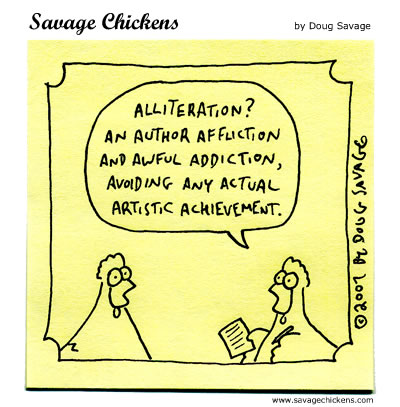
We all were taught literary terms in school, especially during some poetry unit. Simile, metaphor, personification and many others were supposed to be the common vocabulary and grammar we used to dissect the poems.
This month's model poem for our prompt is one that is titled with a literary term - alliteration. The poem itself is no ars poetica though.
Alliteration
by Paul Hostovsky
I whacked off in these woods once.
But that was a long time ago when
everything rhymed a little with
the trees all facing upward and the sky
was full of itself and no one
was around. And everything smelled good.
I smelled good myself. A sweaty,
muddy, musky, burning smell of
autumn or late summer or very early
spring was in the air, and I was so
excited to be so young and existential
and solipsistic, that I peeled off my shirt
and pants and underpants, and stood there
erect and steeply rocking under a sycamore,
my peeled bark in a little pile at my feet,
my head tossing in the wind, my mouth
opening, wider, wider, as if trying
to pronounce all the vowels at the same time
and failing deliciously, and sinking down
to the ground, totally spent and spluttering
a few choice consonants like kisses meant
for the pursed lips of the wind.
We know that alliteration is the repetition of the initial sounds (usually consonants) of stressed syllables in neighboring words. Usually it occurs at word beginnings, as in this line from Shelley's "The Cloud": I bear light shade for the leaves when laid.
The poem has alliteration, but do you see a connection from the term to the poem's subject? Repetition? The "few choice consonants" of spluttered sound? How intentional was it in this somewhat naughty-boy poem that has several puns that another name for alliteration is head rhyme?
For our August prompt, select a literary term as your title and starting point. Besides the common terms, there are plenty of lesser known ones (like half rhyme). And a term like "meter" has many sub-topics to offer. Pentameter and caesura suggest things outside of poetry to me. What would a poem titled "Free Verse" or "Masculine Verse" or "Feminine Verse" address?
To avoid preconceived notions, perhaps you should just browse a list of literary terms for poetry and find one that gets your interest.

 (2012), A Little in Love a Lot (2011), Dear Truth (2009), and Bending the Notes (2008). His poems have won a Pushcart Prize, two Best of the Net awards, numerous chapbook contests, and have been featured on Poetry Daily, Verse Daily, and The Writer's Almanac. He works in Boston as a sign language interpreter at the Massachusetts Commission for the Deaf
 "Alliteration" is from his forthcoming book Naming Names which can be pre-ordered now online.
Paul is online at www.paulhostovsky.com
Subscribe to:
Posts (Atom)